

BLOG
Courtesy of the artist and Monya Rowe Gallery, New York
FOLLOW
“First Look: New Art Online”
the New Museum’s online
projects series
January 23 2013
6:34 PM
The New Museum—that Lower East Side/SoHo stalwart of contemporary art and now an icon for the meeting of institutions and experimentalism — recently opened a different kind of off-site space: this time, a series of online projects and commissions to be featured on the New Museum’s monthly First Look: New Art Online website. Created to celebrate the New Museum’s 35th anniversary, the project incorporates the New Museum’s extensive digital archive, which contains over 6,000 images by over 3,700 artists, but mostly consists of new commissions and pre-existing online projects with little circulation: for Jonas Lund’s (b. 1984) project Public Access Me (2012), the Swedish artist set up a feed linking his computer to users’ own screens at home, enabling them to track the artist’s online dérives through Facebook and Gmail. The site launched this fall with Taryn Simon and Aaron Swartz’s “Image Atlas”(2012), which makes transparent the world of search terms and results-indexing by allowing users to tamper with algorithms and hierarchies used by search engines. It’s no surprise that the curator behind this is Lauren Cornell, curator of the 2015 “The Generational” Triennial, Museum as Hub and Digital Projects—after all, before this stint, Cornell was Executive Director of Rhizome, the New Museum’s hub for the presentation and preservation of digital and online-only art. (Pablo Larios)

Courtesy of the artist and Clifton Benevento, New York
MEET
Chicago-based artist Paul Cowan
January 16 2013
9:08 PM
There’s something Midwest-feeling about the work of Chicago- based artist Paul Cowan (b. 1985, Kansas City, MO), with its signage, its tucked-away industrialism, its thinking on and about margins. Cowan’s recent exhibition at Clifton Benevento in New York took its title from Melville’s Marginalia, a virtual archive of the marginal notes made by the American author in his own books. The exhibition, focusing on partitions, marginalia, and the periphery, included the painting Untitled (2011); for this piece, Cowan hired two sign painters, also based in Chicago, who hardly spoke Spanish to create a sparse painting in primary colors—a yellow squiggle, a blue curve and a red right-angle. The result looks like a PowerPoint animation, vibrant yet empty, with some of Laurence Weiner’s diagram-like lines of motion. The emphasis on artistic process — the problem of translation between the artist and two Spanish-speaking outsourcee — leads to a deceptive clash between final object and procedure. In other works from 2012, the discreet minimal gesture of painting a gallery room references the fact that when one paints a room, the sense of smell declines as the color’s lasting power takes hold; and a fishing lure on a canvas seems like a formal diagram of flat futility. Cowan’s solo exhibition at the MCA Chicago opened last November and is on through early March. (Pablo Larios)

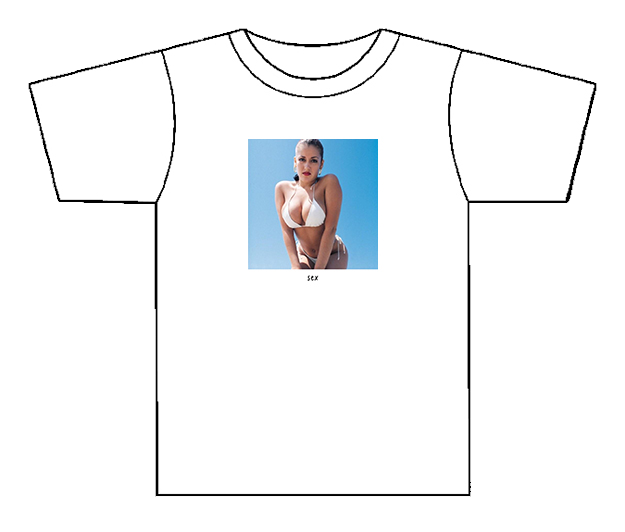
Courtesy of Sex Magazine
FOLLOW
Asher Penn’s online editorial project “Sex Magazine”
December 14 2012
12:25 PM
Hanging up in my room right now is a promotional T-Shirt designed by Alex Damianos to promote Sex Magazine, a new free online publication: a white Hanes t-shirt with a crummy image of the busty beach babe from Richard D. James’ “Windowlicker” (1999) single (designed by Chris Cunningham), on which James superimposed his chavvy mug over the model’s face. Except that Sex’s shirt deappropriated the image by reinstating the model’s original face, which looks creepier and more sullen as a result. The gesture captures the pitch and invective drive of Sex, whose first issue was released in fall 2012 as a response to the “stalemate” between Internet and print in contemporary publishing. The current Sex features an interview with Art Club 2000’s Danny McDonald and Berlin fashion label Bless’s Manuel Raeder, a snarky talk with singer Dan Bodan, and fashion/food/photography/film dispatches. Whereas many publishing outfits are embracing digital formats—with a speed that recalls the URL bubbles of the dot-com boom—Penn misses the trashy, speedy, and lo-fi quality of independent publishing culture. Sex, with its straightforward bold Courier font and sparse HTML, fuses these traits with a personal cultish interest in celebs and a consumerist slant. Readers can access James’ now-missing smirk in concentrated form on Sex’s website: the menacing smiley face from an ecstasy pill ☺ that serves as the site’s favicon. (Pablo Larios)
The second issue of Sex Magazine is getting launched tomorrow December 15th, and features among others Thuy Pham (Bernadette Corporation), Jordan Wolfson, Thomas Bullock (Rub ‘n Tug), Jacqueline de Jong (The Situationist Time), Harsh Patel and Laurie Spiegel.

Courtesy of the artist and Badlands Unlimited
READ
Rachel Harrison’s
“The Help, A Companion Guide”,
an eBook published by
Badlands Unlimited
July 11 2012
4:48 PM
An art-handler friend in New York has some stories about installing in buyers’ ritzy apartments: a doorman’s insistence that he ride the service elevator up; having a maid point out where the de Kooning’s supposed to go.
One doesn’t really ‘flip’ through eBooks so much as enter their hybrid worlds, which can mix print conventions with the scattered way of reading we’ve picked up from the web. iBooks’ goofy page-turn effect works well with Rachel Harrison’s The Help, A Companion Guide, a hilarious and off-kilter edition released for iPad and iPhone by Badlands Unlimited, Paul Chan’s art book publishing outfit. The book was inspired by Harrison’s show, The Help (2012), at Greene Naftali in New York, but there are no finished gallery shots, nor any standard catalogue text. Instead we’re bombarded with snippets of Harrison’s reference materials and numerous shots from the installation of her exhibition.
The theme, of course, is the “help”: the research sources and people that surround the polished final exhibition: the denim-clad art-handlers wrapping up Harrison’s speckled foam sculptures beside buckets of cleaning fluid and stray packing tape. There, photos of colored-pencil drawings depicting Amy Winehouse singing to caricatures inspired by early Picasso paintings; Google image searches; newspaper clippings (from Malaysia, I think) about basketball teams and 90s rappers; scans of ceramics from old art catalogs. You’re offered a taste of the artist’s colorfully neurotic research process, sensing the stench of cigarette smoke in a Chelsea alleyway during an overworked gallery registrar’s lunch break. (Pablo Larios)
'Turbo Sculpture' (video still), 2009-2012
MEET
Artist Aleksandra Domanović
June 14 2012
9:56 AM
Aleksandra Domanović tells me that during the installation of her piece for the 4th Marrakech Biennale this year, it somehow went missing. Apparently, authorities came in the night and relocated the outdoor sculpture because it obstructed the pathway where the Princess takes her morning stroll. History is a series of ironies and here the joke was on the monarch. The piece was a monolithic pink fist in abstraction called Monument to Revolution (2012). The relocation was doubly fitting, because Domanović’s videos and sculptures deal with those dysfunctional siblings, art and politics. For 19:30 (2010), a project exhibited at New York’s New Museum, Domanović collected music intro hooks (called idents) from news stations in the former Yugoslavia to assess how the rhythm of news-watching in times of political turmoil becomes psychologically, and musically, encoded in individuals. At times, seeing her pieces is like finding a Nike shoe peeking out behind the shroud of Turin. “Low” culture meets its institutional other, where it creeps up unexpectedly into political and aesthetic regimes. After the wars in Yugoslavia cities found themselves hunting for political emblems untainted by the complications of war. Public sculptures of Bill Clinton and Bruce Lee began to spread throughout the area. Turbo Sculpture (2009-2012), a video essay shown at Domanović’s solo show at the Kunsthalle Basel this year, is an archive of this phenomenon and a fascinating take on the movement of icons in our bizarre, networked age. (Pablo Larios)
Courtesy of the artist and Kunsthaus Bregenz
Photography by Markus Tretter
VISIT
”Vo Danh,” Danh Vo’s Exhibition Kunsthaus Bregenz
June 5 2012
11:26 AM
Andy Warhol’s Coke paintings captured the everydayness of the American product - a coke is a coke is a coke. Danh Vo’s solo show at Kunsthaus Bregenz gives us the nasty underlayer to corporate demagoguery. By embossing cardboard shipping boxes with Coke labels made of gold foil, where a small Vietnamese phrase is legible beneath the logo. Iconographic planes—a box from a piece of Samsonite luggage, a colonial-era American flag, a Grimm fairytale in German blackface—are layered and hung in the Kunsthaus’ severe stairwell, turning it into an apocalyptic hall of corporate post-nationalism. But instead of a heavy-handed anthropology of the global, Vo offers a personal, almost Mallarméan gesture of image-creation in the face of the abyss: the artist’s name, when inverted as in the show’s title, means “Without Name.” Such facelessness touches on the fragility of art-making as well as the anonymities of the immigrant experience. Both are, after all, products of transit. Here the Statue of Liberty and a Jim Beam whisky bottle are flattened out, as if one and the same. The narratives are both grandiose and unstable, something between national spectacle and the white lie. (Pablo Larios)
Installation view at T293, Naples
Courtesy of the artists, T293
Photography by Maurizio Esposito
VISIT
“Notes on American Performance” by Calla Henkel and Max Pitegoff at T293, Naples
April 27 2012
1:02 PM
The bar, as a motif, suggests both industrial progress and the institution of debauchery—that is, resource and its Bacchic inversion. For Max Pitegoff and Calla Henkel, “raising the bar” meant opening Times (with Lindsay Lawson) in Berlin’s Neukölln district, a bar that’s part working business, part running art gag, somewhat like Gordon Matta-Clark’s restaurant Food in 70’s SoHo. At their solo show at T293 Naples, Henkel and Pitegoff’s bar-themed paraphernalia, such as faux plastic cocktails and unfinished tile booths, were scattered about the gallery, recalling both candy-colored artistry and faulty economics. Texts about performances, Berlin, the debt crisis, and a recent e-flux journal were UV-printed on aluminum, like hardened memoirs of a night on the town or like crystallized press releases from gallery tours of yore. During the show’s opening, the hanging of framed photographs was billed as a “performance.” It was a tongue-in-cheek gesture toward art’s divisions of labor and, somehow, a flirt with the celeb politics of the Eurozone (“lower on the Right”). The photographs being hung showed the artists lounging in luxury hotels in Athens, using Facetime in Egyptian cotton towels while the country below rioted. The pieces all amount to an attitude that is both pristine and inflammatory, like a Canal Street knockoff handbag or a bikini bottom floating silently past you on the surface of a pool. Moscow mule, anyone? (Pablo Larios)